Elevate Your Space: A Complete Guide to Gallery Wall Ideas & Layout Tips

Whether you have just moved into a new home or want to breathe new life into your current space, exploring gallery wall ideas is an excellent way to elevate your interior atmosphere. A thoughtfully designed gallery wall not only showcases your personal taste but also instantly transforms a dull, blank wall into a captivating focal point. This article will answer your questions regarding picture wall design and share practical gallery wall layout tips to help you effortlessly create the perfect interior wall decor.
What is a Gallery Wall and How Does It Enhance Home Decor?
What exactly is the definition of a gallery wall?
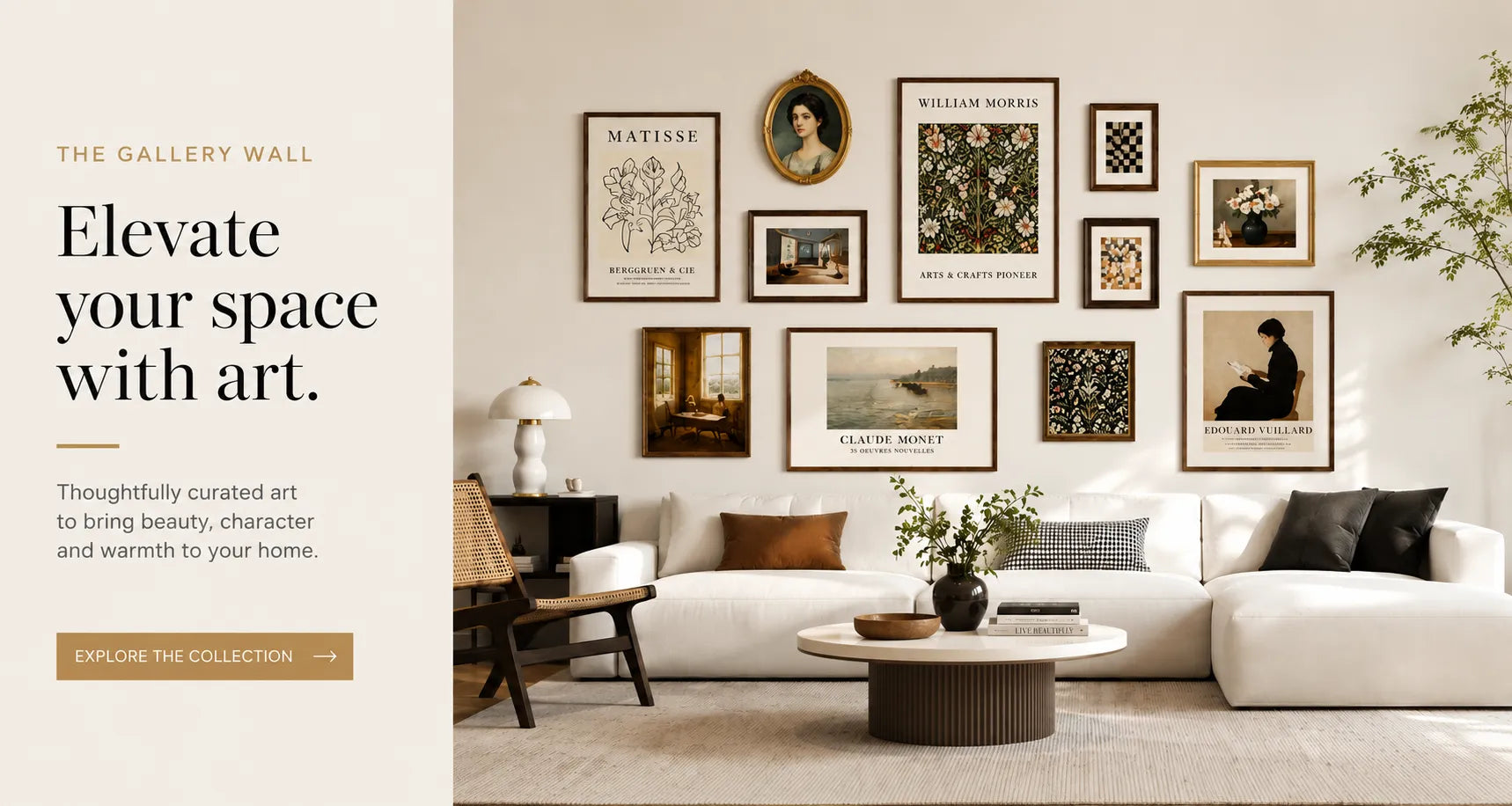
A gallery wall is an interior design technique that involves grouping and arranging multiple art pieces, photographs, posters, or even three-dimensional decorative objects on a wall to create a cohesive visual display. This approach breaks the limitations of a single hung painting. By combining different sizes, frames, and colors, it creates an art arrangement full of depth and storytelling. It is not only suitable for living rooms but also highly effective in hallways, bedrooms, and staircases.
Why should you design a gallery wall in your home?
The core purpose of designing a gallery wall in your home lies in personal expression and spatial optimization. Visually, it effectively fills large expanses of blank space, elevating the overall texture of the room. Emotionally, it serves as the best medium to display family memories, travel photography, or personal art collections. An excellent combination of living room wall art can instantly elevate the artistic tone of your space, making your home feel warmer and more layered.
Inspiring Gallery Wall Ideas to Spark Your Creativity

How can you create a minimalist style picture wall?
The key to a minimalist style lies in "uniformity" and "white space." To achieve this specific set of gallery wall ideas, you should choose frames with uniform colors or identical materials (such as pure black thin frames or natural wood frames). For the artwork itself, opt for black-and-white photography, simple geometric shapes, or line art with ample negative space. When arranging them, use a symmetrical grid layout, ensuring the spacing between each piece is exactly the same, thereby creating a clean, modern, and uncluttered visual effect.
[Image: A minimalist style black and white grid picture wall]
Alt Text: Modern minimalist black and white picture wall design featuring uniform thin black frames.
How should you style an eclectic gallery wall?
The core of the eclectic style is breaking the rules and creating a wonderful chemical reaction through the collision of multiple elements. You can mix frames made of different materials (such as vintage carved gold frames paired with modern minimalist metal frames) and blend classic oil paintings, modern pop art, or even small mirrors and wall-mounted plants. To avoid visual chaos during this mixing process, it is recommended to select one or two main color tones to run throughout the display. When searching for high-quality artwork materials, you can visit the official Inkich website, which offers a rich selection of fine art prints and decorative paintings to provide endless inspiration for your eclectic mix.
Practical Gallery Wall Layout Tips and Techniques
What are the most common gallery wall layout methods?
A logical art arrangement is crucial to the success of your display. Here are some of the most popular layout methods that you can choose based on your wall conditions:
| Layout Method | Best Suited For | Layout Characteristics |
| Grid Layout | Modern minimalist spaces, home offices | All frames are the same size, arranged in a neat rectangular or square array. |
| Staircase Layout | Walls alongside staircases | Extends diagonally along the slope of the stairs, with the bottom of the art parallel to the incline. |
| Organic Layout | Eclectic living rooms, bedrooms | Centers around one large piece, with smaller artworks arranged in an irregular, radiating pattern around it. |
| Picture Ledge | Areas where art is swapped frequently | Uses wall-mounted shelves to lean and overlap artworks, eliminating the need for frequent drilling. |
What dimensions and spacing should you consider when hanging art?
Mastering scientific hanging techniques will make your gallery wall look highly professional. First, the visual center of your gallery wall (the center point of the entire grouping) should be roughly at eye level, typically about 57 to 60 inches (145 cm to 152 cm) from the floor. Second, the spacing between individual frames should be kept between 2 to 3 inches (5 cm to 8 cm). If the frames are particularly large, the spacing can be slightly increased, but you should strive to keep the gaps consistent across the same wall to maintain visual balance and tidiness.
How to Start Building Your Gallery Wall

What are the specific steps to create a gallery wall?
Putting these gallery wall layout tips into practice requires patience and planning. Please follow these straightforward steps:
-
Gather Materials: Select your favorite paintings, photos, or art pieces. To understand the latest interior decor trends, you can reference expert case studies on authoritative home design websites like Houzz.
-
Floor Layout: Do not rush to the wall. Clear a floor space equal in size to your wall area, lay the artwork out on the ground, and experiment with different arrangements.
-
Cut Paper Templates: Cut kraft paper or newspaper to the exact size of each frame. Use painter's tape to stick them to the wall, fine-tuning their positions and spacing.
-
Mark for Drilling: Mark the exact location for the hooks on the paper templates, and drill or hammer nails directly through the paper.
-
Hang the Art: Remove the paper templates, hang your artwork, and use a spirit level to ensure every piece is perfectly straight.
Frequently Asked Questions (FAQ)
Q: Are gallery walls suitable for small apartments?
A: Absolutely! For small apartments, you can design a gallery wall behind the sofa or on a side wall in the dining area. It is recommended to choose smaller frames and arrange them vertically. This not only saves floor space but also visually raises the ceiling height, making the room feel more open and spacious.
Q: I don't want to drill too many holes in my wall. Are there alternative solutions?
A: If you want to avoid damaging your walls, you can use damage-free hanging strips (like Command strips) to hang lighter frames. Additionally, adopting the "Picture Ledge" method is a great alternative; you only need to drill a few holes to secure the shelves, and then you can freely lean and swap out artworks as you please.
Q: Can a TV background wall be turned into a gallery wall?
A: Yes. You can treat the television as one large "black frame" within your gallery wall, arranging other art pieces around it. This interior wall decor method effectively softens the "black hole" effect a TV creates when it is turned off, making the background wall much more engaging and rich.