Kyoto’s timeless spirit, unhurried and intentional, seeped into Aria’s soul from childhood. She spent her days wandering the grounds of Ryoan-ji Temple, watching the way light filtered through maple leaves onto the stone garden, or sitting quietly in her grandmother’s tea house, observing the ritual of matcha—each movement deliberate, each pause meaningful. These moments taught her to see beauty not in excess, but in restraint; not in perfection, but in authenticity. Unlike the bustling energy of modern cities, Kyoto taught her to embrace silence, to notice the subtle shifts of light and shadow, and to find profound meaning in the quiet, unassuming moments of life. This upbringing would later translate into her art, which feels less like a creation and more like a reflection of this quiet, intentional way of being.
Aria’s art is anchored in a gentle yet unwavering artistic attitude: art as a meditative practice, one that honors the harmony between nature, humanity, and the quiet spaces in between. In a world that glorifies noise, speed, and constant productivity, she stands firm in her belief that art should be a sanctuary—a space to slow down, to ground oneself, and to connect with the stillness that resides within. She rejects the idea that art must be bold, loud, or attention-grabbing to have value; instead, she champions subtlety, intentionality, and quiet resonance. For Aria, art is not about making a statement—it is about creating a space for reflection, a moment of peace in the chaos of modern life. “Art should not demand your attention,” she says. “It should invite it—softly, gently, like a breath of wind through a bamboo grove.”
At the core of her creative philosophy is a deep reverence for wabi-sabi—the Japanese aesthetic that celebrates imperfection, transience, and the beauty of the “imperfectly perfect.” Aria was first introduced to wabi-sabi by her grandmother, who taught her that the most precious things in life are those marked by time, wear, and imperfection: a chipped teacup, a weathered wooden spoon, the gnarled branch of a pine tree. This philosophy became the heart of her art, guiding her to embrace imperfection and natural irregularity, rather than fight against them. For Aria, imperfection is not a flaw—it is a mark of authenticity, a reminder of the beauty of being human, of the passage of time, and of the inherent impermanence of all things. “Wabi-sabi is not about settling for less,” she explains. “It is about seeing the beauty in what is—raw, unpolished, and real.”
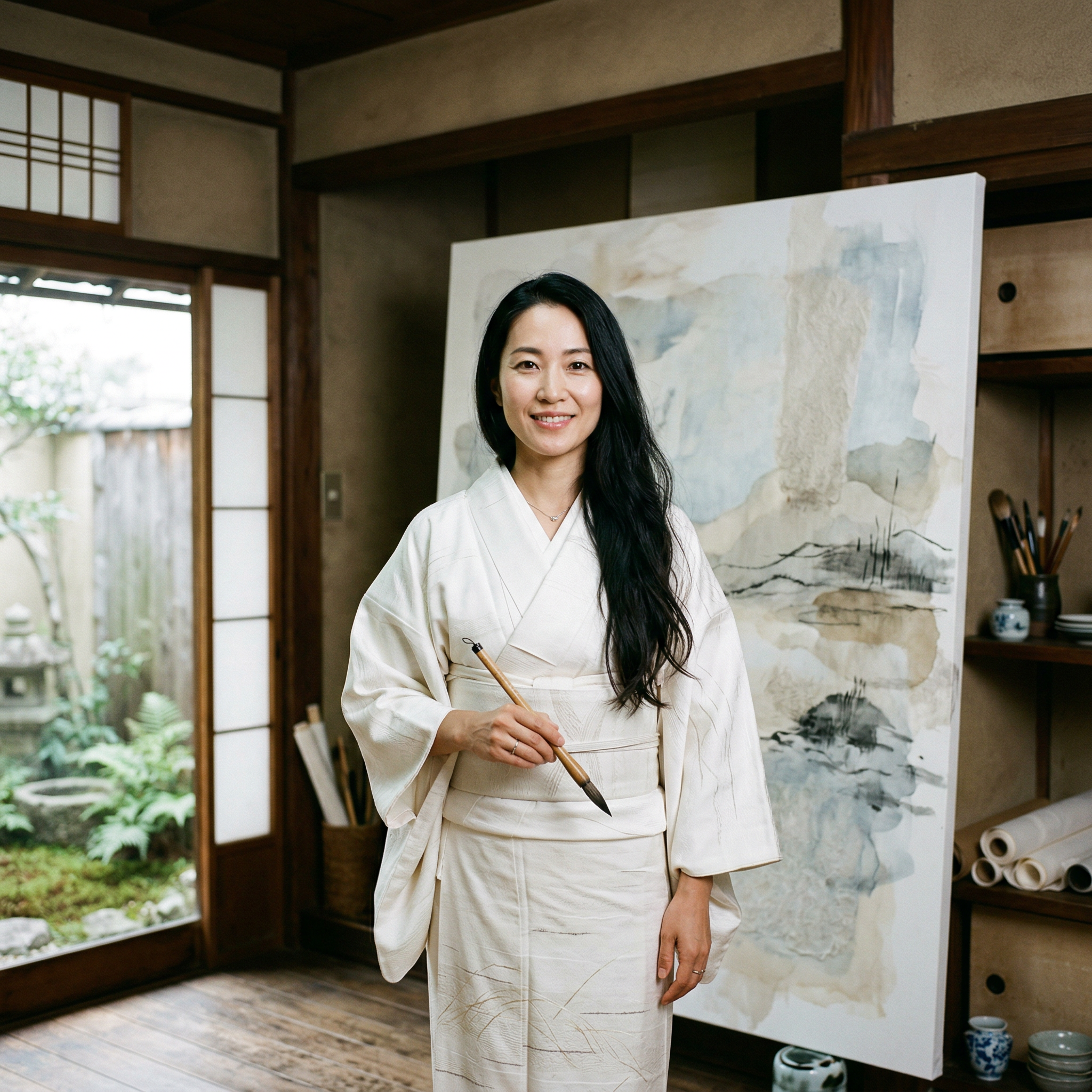
Her paintings are subtle, quiet, and deeply intentional—each brushstroke, each layer of pigment, each choice of color is made with purpose, no detail left to chance. Aria uses a deliberately limited palette—ivory, sand, ash, and muted charcoal—hues that evoke the natural landscape of Kyoto: the pale light of dawn over the Fushimi Inari Shrine, the soft sand of a Zen garden, the ashen gray of a misty mountain morning, and the quiet depth of charcoal from ancient Japanese ink sticks. These colors are not chosen for their vibrancy, but for their ability to calm the mind, to invite reflection, and to create a sense of stillness. She works with thin, translucent layers of paint, often mixed with natural materials like rice flour or bamboo ash, to create delicate, textured surfaces that feel like they have been shaped by time—soft to the touch, with subtle variations that catch the light and invite the viewer to lean in, to look closer, to feel the quiet energy of the piece.
Aria’s guiding mantra—“Silence has a shape. I try to paint it.”—is the thread that weaves through all of her work, encapsulating her entire creative philosophy. For her, silence is not emptiness; it is a tangible, living thing, with its own texture, its own weight, its own shape. It is the silence of a Zen garden at dawn, the silence of a tea ceremony mid-pause, the silence of a forest after rain. Her art seeks to give form to this silence—to translate the intangible into something tangible, something that can be seen, felt, and experienced. To do this, she relies heavily on negative space (ma), a key element of traditional Japanese aesthetics. The empty spaces in her canvases are not afterthoughts; they are as important as the painted areas, creating a balance between presence and absence, between movement and stillness. “Negative space is where the silence lives,” she says. “It is the space between breaths, the pause between thoughts, the quiet that allows the viewer to bring their own emotions, their own stories, to the work.”
Her relationship with her materials is deeply reverent, rooted in a desire to honor nature and tradition. She sources her pigments from small, family-run workshops in Kyoto, where artisans have been crafting natural pigments for centuries—pigments made from minerals, plants, and even charred wood, each with its own unique texture and depth. She uses handmade washi paper or linen canvases, drawn to their subtle texture and the way they absorb paint, giving her pieces a warmth and authenticity that synthetic materials cannot replicate. Aria works slowly, often spending weeks on a single piece, allowing each layer of paint to dry fully, reflecting on its meaning, and adjusting until the piece feels “in balance”—until it embodies the silence and calm she seeks to convey. For her, the act of painting is a form of meditation: she works in a small studio with a view of a bamboo grove, where the only sounds are the rustle of leaves and the gentle drip of water from a small stone fountain. This quiet environment allows her to connect with the stillness she seeks to paint, to channel the energy of Kyoto, and to create work that feels grounded, authentic, and deeply peaceful.
Another cornerstone of her artistic attitude is her belief that art should be a bridge between tradition and modernity. While her work is deeply rooted in traditional Japanese aesthetics and wabi-sabi philosophy, it is not stuck in the past. She creates art for modern spaces, understanding that contemporary life often lacks the quiet, intentional moments that Kyoto’s traditions offer. Her works are designed to bring calm energy into modern spaces, to serve as a reminder of the beauty of simplicity, balance, and imperfection in a world that often values the opposite. She rejects the idea that traditional aesthetics are outdated; instead, she sees them as a timeless antidote to the chaos of modern life, a way to bring a sense of peace and harmony to even the busiest of homes.
Aria’s work is a celebration of quiet beauty, of imperfection, and of the power of silence. It is a way to honor her Kyoto roots, to share the wisdom of wabi-sabi with the world, and to remind people that calm, balance, and authenticity are the greatest forms of luxury. Her paintings do not demand attention; they invite it, softly and gently, offering a moment of peace in a noisy world. For Aria, art is not just about creating something beautiful—it is about creating something that nourishes the soul, that brings calm to the mind, and that gives shape to the silence we all crave.
Perfect for: Japandi interiors, meditation rooms, luxury apartments—spaces that value calm, simplicity, and intentionality, where art serves as a quiet companion that enhances the peace and harmony of the space.