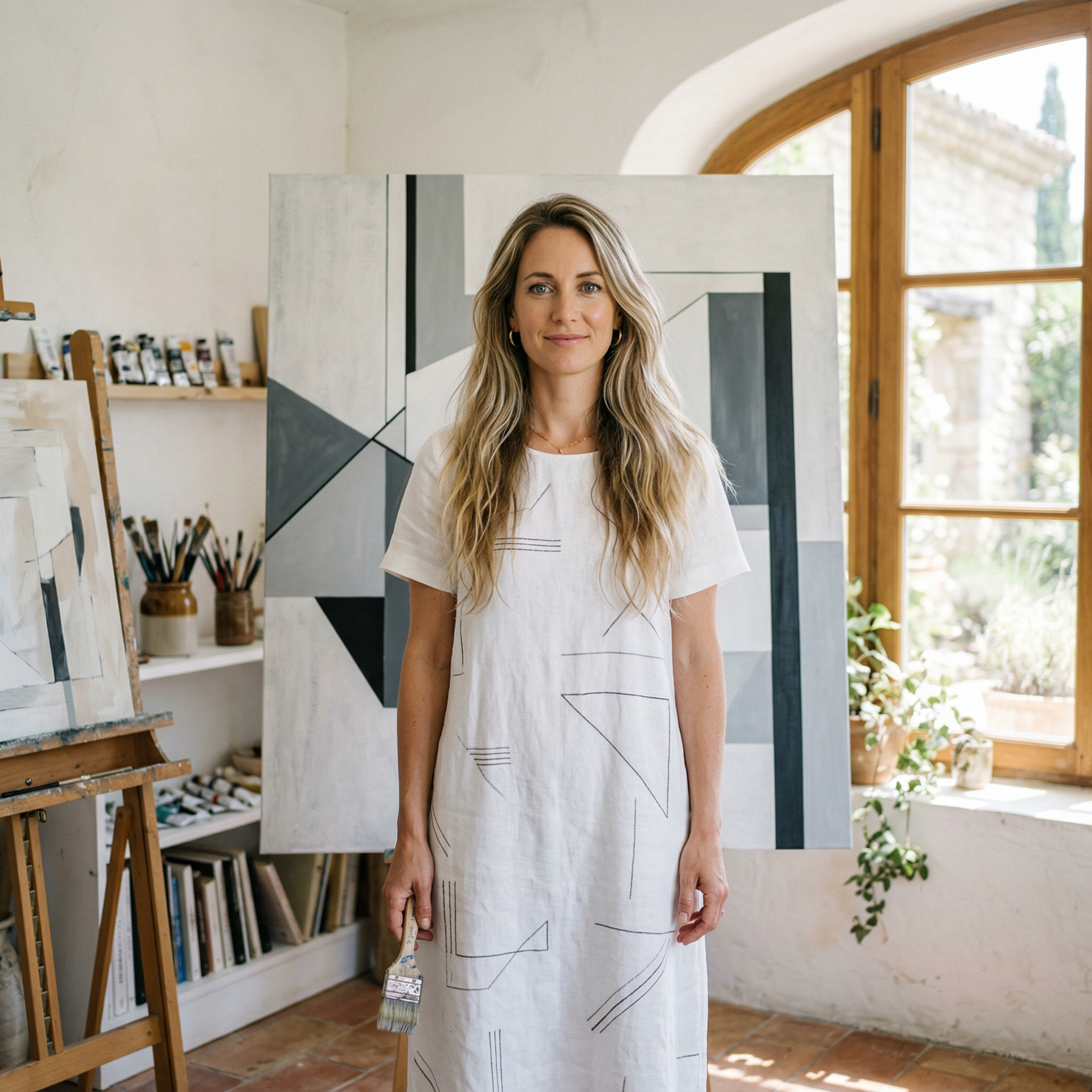
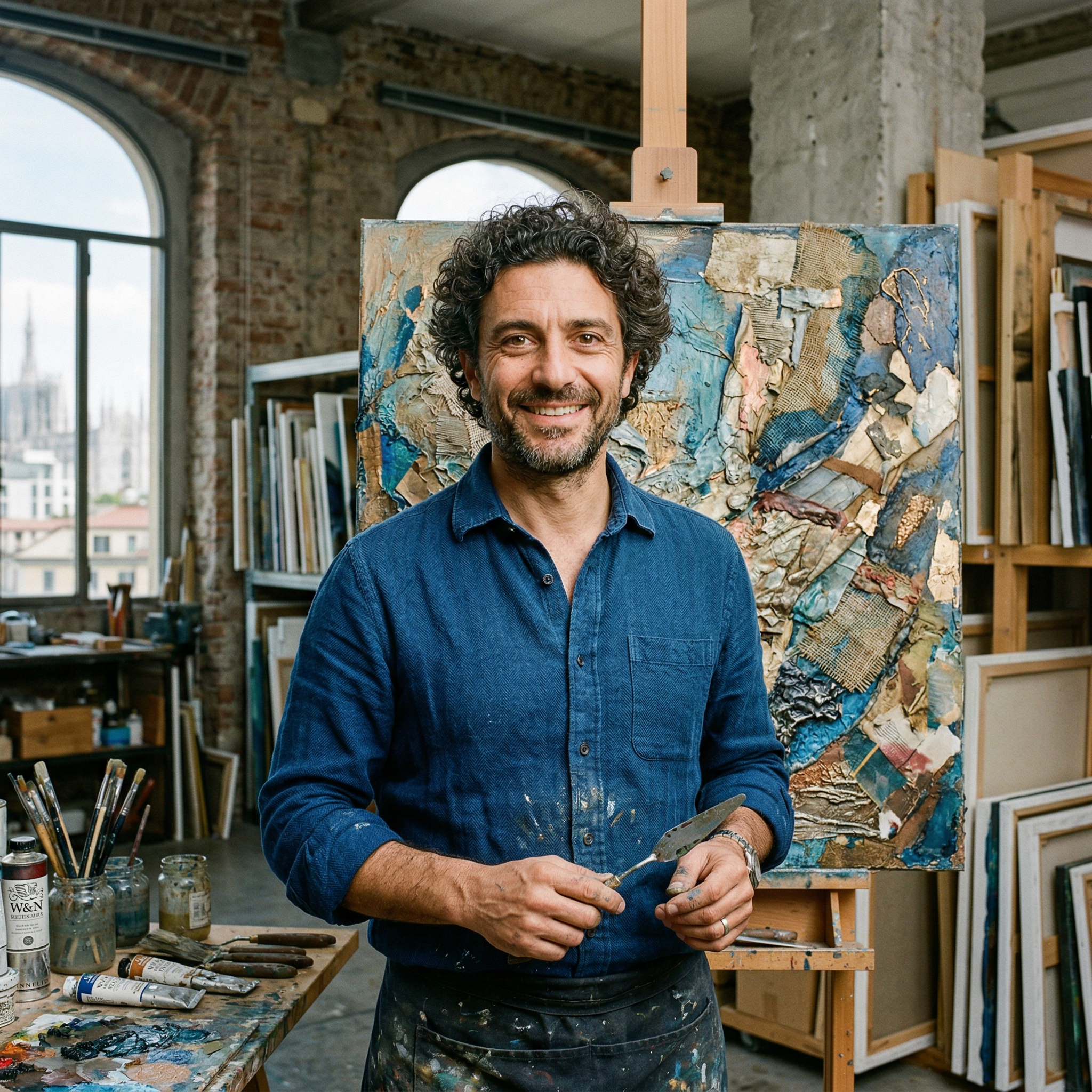
Style: Monochrome Expressionism
Based in: London, UK

Story:
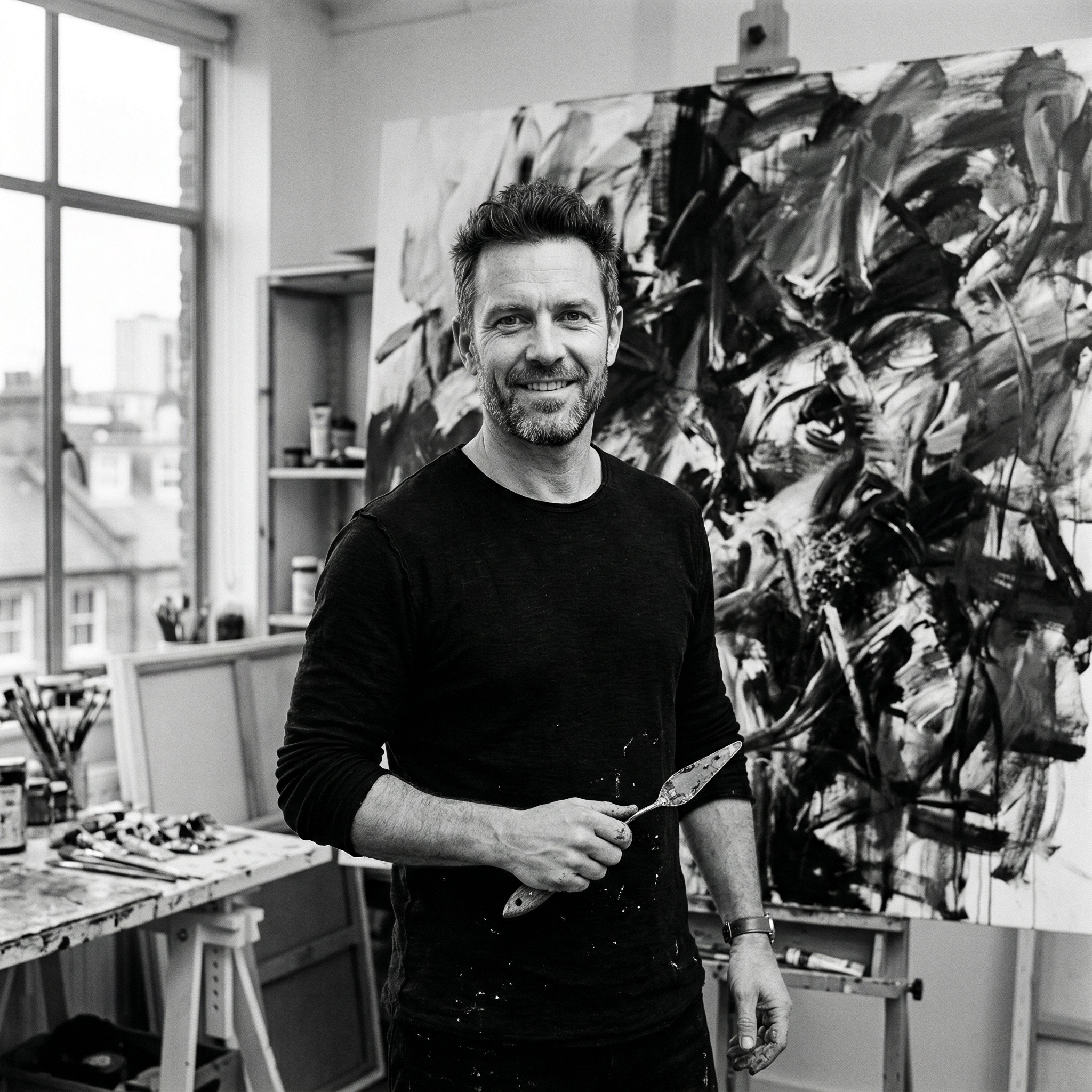
Adrian Vale’s artistic journey is rooted in the dynamic, contrasting energy of London—a city where historic cobblestone streets collide with sleek modern skyscrapers, where fog-draped mornings give way to sharp, neon-lit nights, and where chaos and order coexist in every corner. It is this duality that fuels his work, which centers on exploring the tension between contrast—light and shadow, chaos and control, raw emotion and intentional form. London’s urban landscape, with its stark black-and-white aesthetics, its dramatic play of light through city grids, and its unfiltered, unapologetic energy, is not just a backdrop for Adrian’s art; it is the very essence of it, seeping into every bold brushstroke and every deliberate imperfection.
Before finding his voice in fine art, Adrian spent years working in graphic design—a world defined by digital precision, pixel-perfect layouts, and the pressure to create “flawless” work. For years, he navigated the constraints of software tools, where every line could be adjusted, every color calibrated, and every imperfection erased with a single click. While he honed his eye for composition and contrast in this field, he eventually felt suffocated by the rigidity of digital perfection. It was a quiet rebellion—an urge to break free from the screen, to embrace the messiness of human expression, and to create art that felt alive, unpolished, and true—that led him to transition into fine art. This shift was not a rejection of his graphic design roots, but an evolution; he brought his keen understanding of contrast and composition to his paintings, while shedding the need for digital precision in favor of raw, unfiltered emotion.
Adrian’s art is anchored in a bold, uncompromising artistic attitude: art as unfiltered emotional truth. In a world that often glorifies polish, perfection, and curated appearances, he stands firm in his rejection of superficiality. He believes that art’s power lies not in its flawlessness, but in its ability to capture the messy, contradictory, and authentic emotions that make us human. “Digital design taught me how to control every detail,” he says. “But fine art taught me how to let go—to let emotion lead, and to embrace the imperfection that makes art feel real.” This attitude is reflected in every aspect of his practice, from the way he paints to the philosophy that guides him: art should not be a performance of perfection, but a raw, unedited expression of what it means to feel.
At the core of his creative philosophy is a rejection of revision and a celebration of immediacy, encapsulated in his guiding mantra: “Emotion first. Perfection never.” Adrian believes that true emotional resonance is lost when art is overworked, revised, or polished to death. For him, the magic of creation lies in the fleeting, unplanned moments—the split-second decisions, the spontaneous brushstrokes, the raw emotion that can only be captured in the heat of the moment. This is why each of his paintings is created in a single flow session—never revised, never adjusted, never second-guessed. He approaches the canvas with no pre-drawn plans, no sketches, no agenda; he simply lets his emotions guide his hand, allowing chaos and control to dance together in a delicate balance.
His monochrome pieces are a deliberate choice, a way to strip art down to its essence and focus on what matters most: emotion, contrast, and movement. By limiting himself to black, white, and the endless shades of gray in between, Adrian eliminates the distraction of color, forcing the viewer to engage with the raw power of form, texture, and emotion. His work embraces imperfection—brushstrokes that are uneven, edges that are jagged, layers of paint that overlap in messy, beautiful ways. These “flaws” are not accidents; they are intentional, a reflection of his belief that imperfection is a mark of authenticity, a reminder that emotion is not neat or controlled, but wild and unruly.
Bold brush strokes are the language of Adrian’s expressionism—thick, confident marks that carry the weight of his emotions, whether it’s the intensity of frustration, the calm of quiet reflection, or the chaos of unbridled passion. He uses a variety of brushes, from wide, flat tools that create sweeping, dramatic strokes to thin, pointed ones that add delicate, precise details—each stroke serving a purpose, each contributing to the overall emotional narrative of the piece. There is a sense of movement in his work, a dynamism that makes even static canvases feel like they are in motion—like the energy of London itself, constantly shifting, evolving, and surprising.
Adrian’s relationship with his materials is visceral and unmediated. He works primarily with oil paints, drawn to their thickness, their ability to hold texture, and the way they dry slowly, allowing him to build layers and blend tones in the heat of his flow session. He rejects digital tools entirely in his fine art practice, choosing instead to work with his hands, to feel the weight of the brush, the texture of the paint, and the resistance of the canvas. For him, this physical connection is essential—art is a tactile, bodily experience, not a digital one. “When I paint, I’m not just creating a piece,” he explains. “I’m pouring a piece of myself into the canvas—my emotions, my frustrations, my joys. That physicality, that imperfection, is what makes it real.”
Another cornerstone of his artistic attitude is his belief that art should reflect the world around him—specifically, the urban energy of London. His work is a response to the city’s contrasts: the light filtering through rain-streaked windows, the shadow of a skyscraper stretching across a historic square, the chaos of a busy market and the quiet calm of a empty alley at dawn. He captures this duality in his paintings—moments of chaos balanced by moments of control, bold shadows softened by subtle light, rough textures paired with smooth, deliberate lines. His art is not just about emotion; it is about the dialogue between the artist and the city, between the self and the world.
Adrian’s work fits seamlessly into urban, masculine, or high-contrast interiors—spaces that embrace boldness, simplicity, and authenticity. In a world of muted tones and safe design choices, his monochrome pieces stand out, adding depth, drama, and a sense of raw energy to any space. They thrive in black-and-white spaces, where their contrast and texture take center stage; in modern lofts, where their boldness complements the industrial aesthetic; and in contemporary offices, where their dynamic energy inspires focus and creativity. “Art should not blend into the background,” he says. “It should demand attention—not with flash, but with truth.”
For Adrian, art is a rebellion against perfection, a celebration of imperfection, and a testament to the power of raw emotion. It is a way to escape the constraints of digital precision, to connect with his authentic self, and to capture the dynamic energy of London in every brushstroke. His work is not just monochrome expressionism; it is a manifesto—an assertion that emotion is more important than perfection, that imperfection is more beautiful than polish, and that art is at its best when it is raw, unfiltered, and true.
Perfect for: Black & white spaces, modern lofts, contemporary offices—spaces that value boldness, contrast, and authenticity, where art serves as a dynamic, emotional focal point that elevates the urban aesthetic.