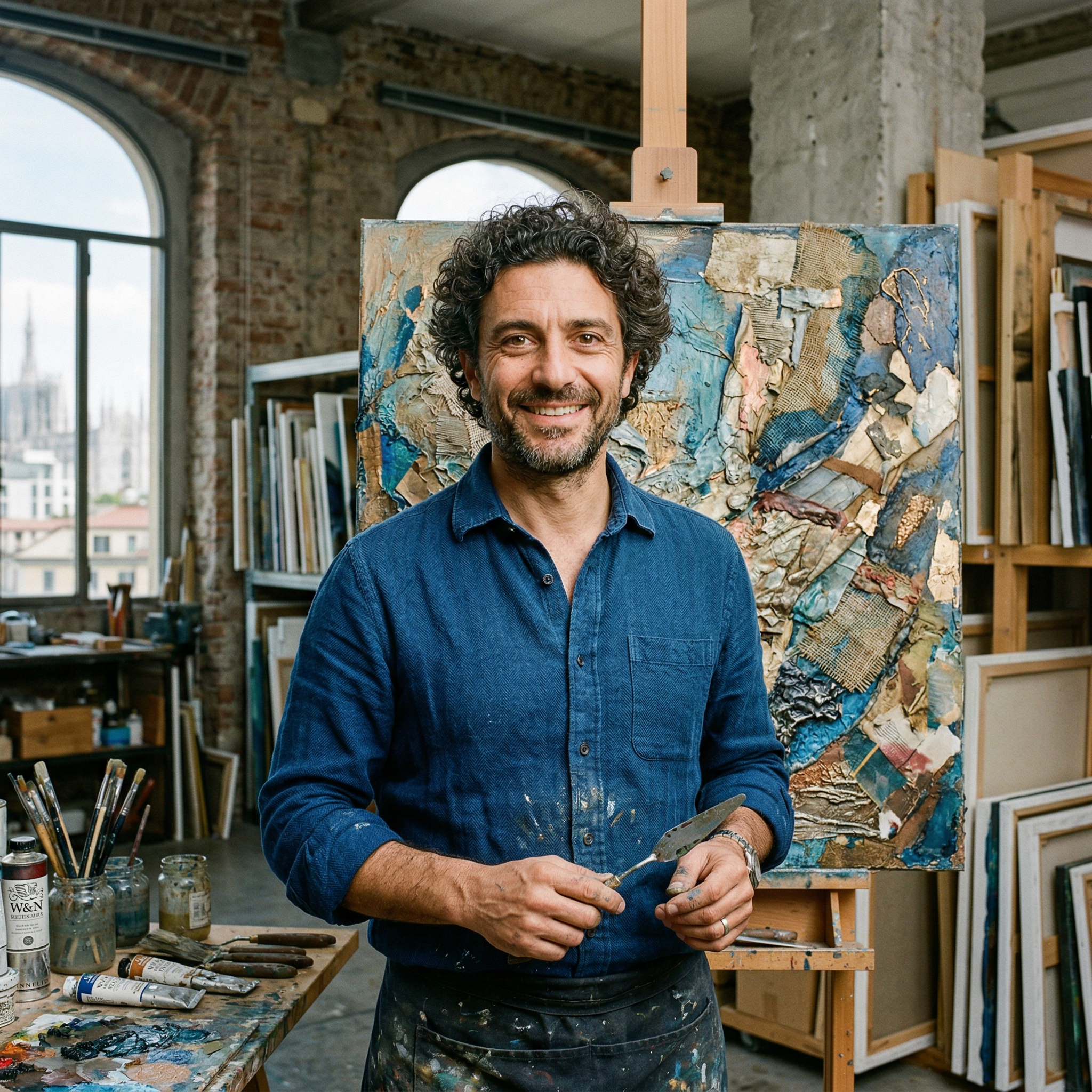
Style: Contemporary Texture Art
Based in: Milan, Italy
Story:
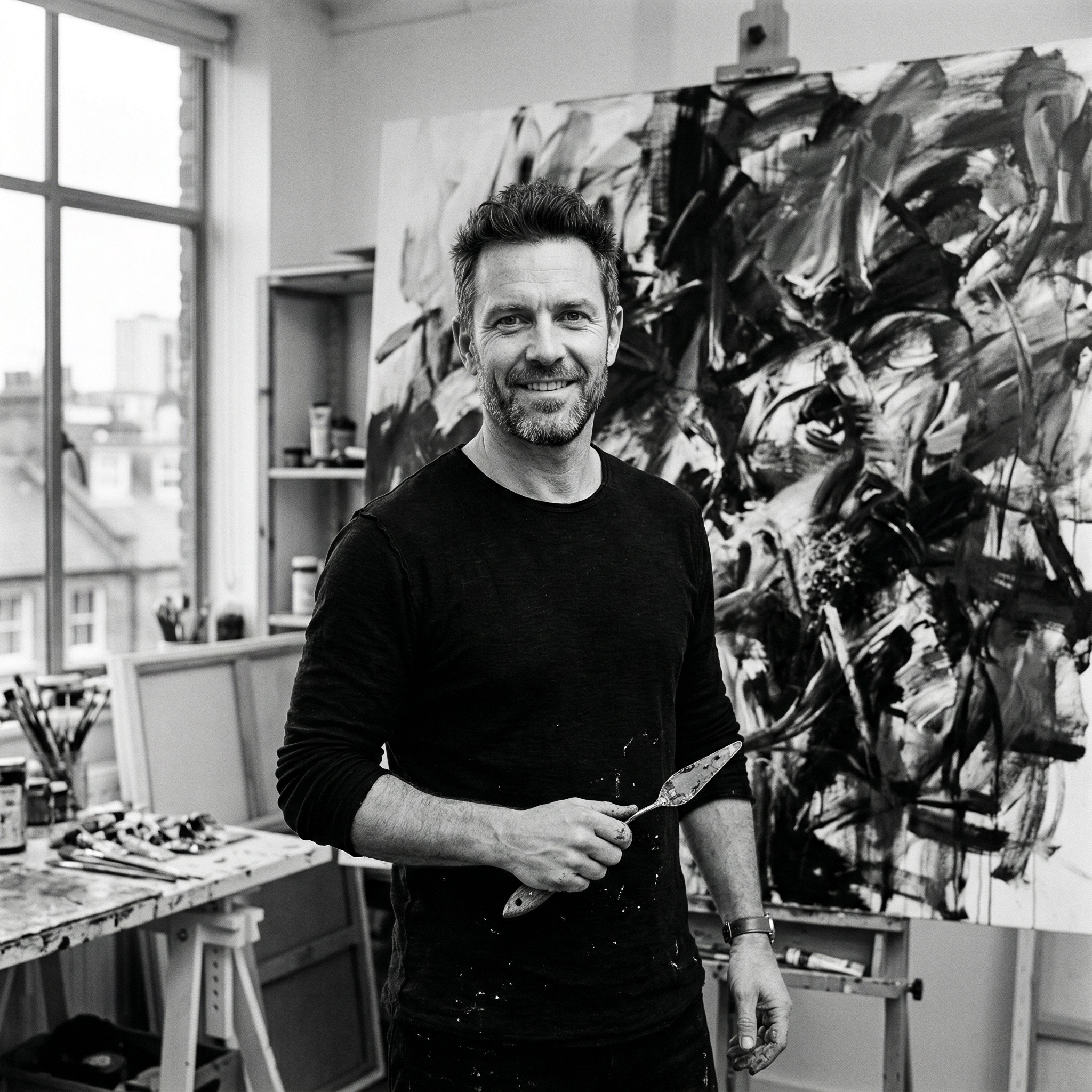
 Born into a family of architects in Milan, Italy—a city where timeless elegance meets cutting-edge innovation, where historic marble facades stand alongside sleek, modern skyscrapers—Matteo Virelli was fascinated by structure, form, and materiality from a young age. His childhood was spent wandering the drafting rooms of his family’s architecture firm, running his fingers over blueprints, tracing the lines of column designs, and marveling at how raw materials could be shaped into spaces that feel both functional and soulful. While his relatives dedicated their lives to building structures that frame human life, Matteo made a deliberate choice: to trade blueprints for canvases, and concrete for paint, plaster, and sand—turning his obsession with structure into a medium of emotional expression, rather than functional design.
Milan, a global hub of art, fashion, and design, became the perfect backdrop for Matteo’s artistic evolution. The city’s unique duality—its reverence for tradition and unapologetic embrace of the contemporary—seeped into his work, shaping his approach to texture and form. Unlike the rigid rules of architecture, which demand precision and practicality, art offered him freedom: the freedom to experiment, to subvert expectations, and to create pieces that prioritize feeling over function. For Matteo, this shift was not a rejection of his architectural roots, but an extension of them; he simply traded the logic of buildings for the intuition of art, using the same eye for structure to craft textured canvases that feel like three-dimensional landscapes, waiting to be explored.
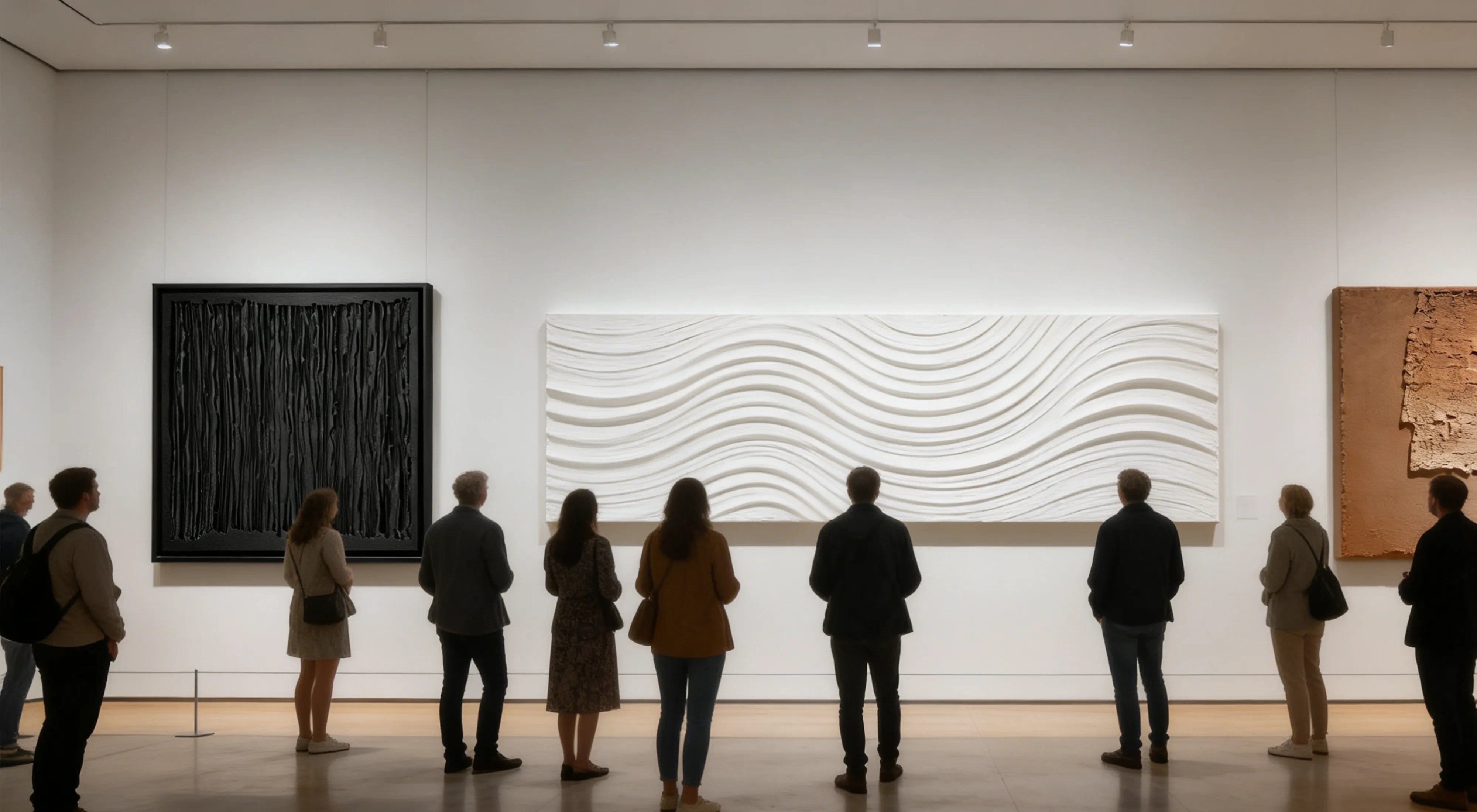
Matteo’s art is anchored in a bold, uncompromising artistic attitude:art as a tactile experience. In an era dominated by digital screens and fleeting visual encounters, he rebels against the idea that art should be a passive, distant viewing experience—something to be admired from afar, but never touched, never felt. He believes that art loses its essence when it is reduced to a mere visual object; it must engage the senses, stir physical and emotional responses, and bridge the gap between the viewer and the work itself. “Too often, art is kept behind glass, untouchable, cold,” he says. “I want to break that barrier. Art should not be a spectator sport—it should be a conversation, one that you feel with your hands, your eyes, your entire body.” This attitude drives every aspect of his practice, from the materials he chooses to the way he displays his work, all designed to invite connection, not distance.
His creative philosophy revolves around the primacy of depth and material—two concepts deeply rooted in his architectural upbringing, yet reimagined through the lens of contemporary art. At the core of this philosophy is his guiding mantra: “Art should not only be seen — it should be felt.” For Matteo, texture is not an afterthought or a decorative detail; it is the very language of his art, the medium through which he communicates emotion, memory, and the essence of materiality. He rejects the flatness of traditional painting, seeing it as a limitation—how can art truly convey the complexity of human feeling if it does not have the depth to be explored, the texture to be touched?
To bring this philosophy to life, Matteo’s works focus on depth and material in ways that feel both intentional and experimental. He eschews conventional paint alone, instead combining plaster, sand, crushed marble (a subtle nod to Milan’s architectural heritage), and layered pigments to create dimensional surfaces that shift and transform under different light. Each material is chosen for its unique tactile quality: the rough grit of sand, the smooth, cool density of plaster, the subtle grain of crushed stone. He layers these materials meticulously, building up the canvas like an architect builds a wall—one layer at a time, each adding depth, texture, and meaning. Sometimes he scrapes away layers to reveal what lies beneath, creating a sense of history and imperfection; other times he builds up thick, sculptural peaks that invite the viewer to reach out and touch, to feel the ridges and valleys of the surface.
Matteo’s relationship with his materials is deeply intimate and reverent. He sources his plaster from a small, family-run workshop outside Milan, where artisans have been crafting traditional building materials for generations; his sand comes from the shores of Lake Como, its fine grains carrying the quiet beauty of northern Italy. He believes that materials have their own stories—of origin, of craft, of time—and that his role as an artist is to honor those stories, not overwrite them. For him, the act of creating is a dialogue with the materials: he lets their texture guide his hand, their weight inform his choices, and their natural properties shape the final piece. “I don’t control the materials,” he explains. “I collaborate with them. They have a voice, and I want that voice to be heard in every piece.”
Another cornerstone of his artistic attitude is his rejection of “empty beauty”—art that is visually striking but lacks substance. He believes that contemporary art should be both aesthetically bold and emotionally resonant; it should catch the eye, but it should also linger in the mind and stir the heart. His pieces carry subtle movement—not in the sense of literal motion, but in the way their texture shifts with light, the way shadows play across their surfaces, and the way they invite the viewer to move around them, to see and feel them from every angle. A piece that looks smooth and muted in natural light might appear rich and dimensional under warm indoor lighting, revealing new details and textures with each shift—this subtlety is intentional, a reflection of his belief that art, like life, should be full of nuance and discovery.
Matteo’s work is designed for modern luxury spaces, not because it is ostentatious, but because it complements the sleek, sophisticated aesthetic of contemporary design while adding warmth, depth, and a tactile element that often feels missing in minimalist or modern interiors. He believes that art should elevate a space, not compete with it—and his textured pieces do just that: they add character without overwhelming, depth without clutter, and a sense of craftsmanship that feels rare in a world of mass-produced art. “Modern luxury is not about excess,” he says. “It’s about quality, intention, and feeling. My work is for spaces that value those things—spaces that feel curated, not decorated.”
For Matteo, art is a celebration of materiality, of touch, and of the quiet connection between the viewer and the work. It is a way to honor his architectural roots while forging his own path, to bridge the gap between structure and emotion, and to remind people that art is not just something to look at—it is something to feel. In a world that often prioritizes the visual over the tactile, Matteo Virelli’s contemporary texture art is a powerful reminder of the beauty of touch, the depth of material, and the magic of art that breathes with life.
Perfect for: Modern villas, designer living rooms, statement walls—spaces that demand art with presence, depth, and a tactile quality that elevates the entire room.